Announcement
Admissions Open for Session 2026-27 (Nursery to Class 8)Special Coaching Batches for AMU, JMI, Sainik School, and Vidyagyan!Call Admissions Desk at +91 9412137554Submit Online Form to reserve your evaluation seatAdmissions Open for Session 2026-27 (Nursery to Class 8)Special Coaching Batches for AMU, JMI, Sainik School, and Vidyagyan!Call Admissions Desk at +91 9412137554Submit Online Form to reserve your evaluation seat
View Process →
Home /Blog /NEP 2026 Updates
School News

New Education Policy (NEP) 2026: 5 Major Changes Parents Must Know Before Next Academic Year

?? Date: July 4, 2026?? Author: Rifaul Hasan?? Read time: 7 mins
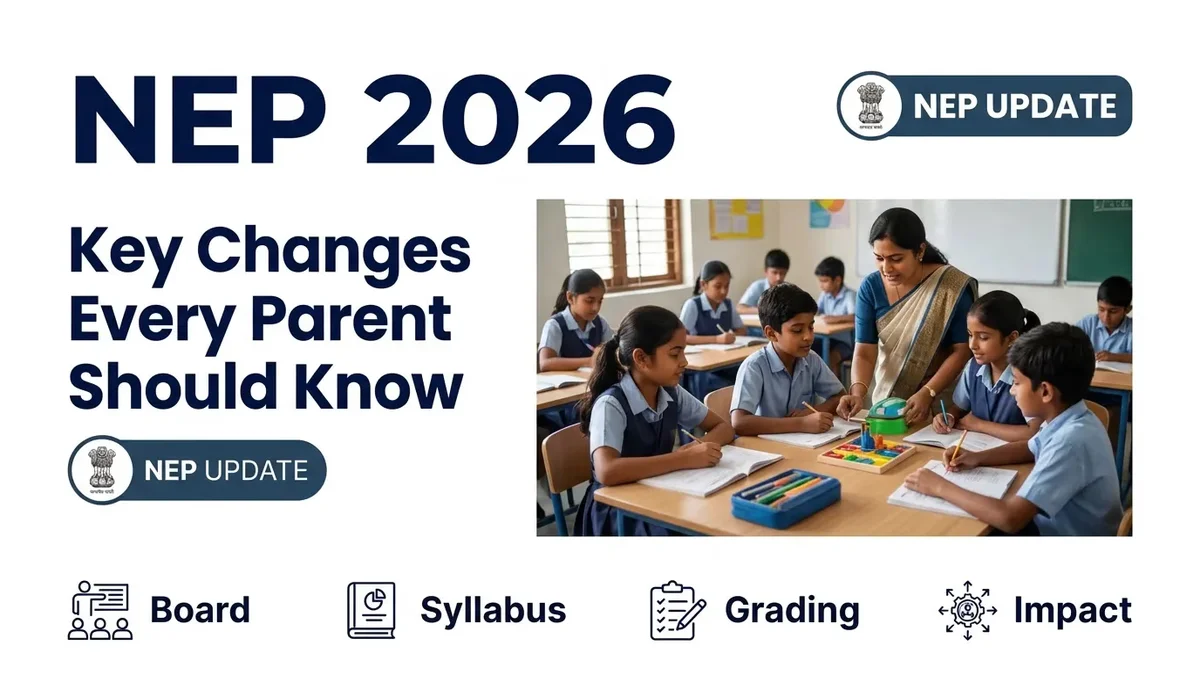
Indian students studying intently in a modern classroom

Your child's school will look very different this year. The New Education Policy 2026 is now live across India. The old 10+2 system is gone. A new 5+3+3+4 structure has taken its place. Over 1.5 million teachers have already trained for this change. You need to know what this means for your child right now.

Rote memorization no longer works. Board exams will test thinking, not memory. Your child must learn to solve real problems. Here are the key changes you cannot afford to miss.

1What Is the New Education Policy 2026?

The New Education Policy 2026 is India's updated plan for how schools teach. It changes the old 10+2 system to 5+3+3+4. This means four stages of learning instead of two blocks.

The first five years cover ages 3 to 8. Children learn through play and exploration. The next three years focus on building basics in science and math. Then three years of middle school bring abstract ideas. The last four years go deep into subjects your child chooses.

This policy also adds coding, AI, and skill classes from Class 6. Board exams will happen twice a year. The goal is simple: teach children to think, not just memorize answers.

2 What Are the Key Differences: Old System vs. New System?

FeatureOld System (10+2)New Education Policy 2026
Structure10 years + 2 years5 + 3 + 3 + 4 years
Board ExamsOnce a year, Class 10 & 12Twice a year, best score counts
Skill ClassesOptional or not offeredMandatory from Class 6
Language RuleOne language requiredThree languages, two must be Indian
Exam StyleMemory-based questionsThinking and problem-solving

3Who Is Affected?

  • Children ages 3-8: Now in the foundational stage. Play-based learning is the focus.
  • Classes 6-8 students: Must pick skill subjects like coding, AI, or carpentry.
  • Classes 9-12 students: Board exams twice a year. No hard split between Arts, Commerce, and Science.
  • Parents of Class 10 & 12 students: Your child can retake board exams to improve scores.
  • Every Indian school: CBSE, ICSE, and state boards must follow the new structure by 2026-27.

4 What Are the Key Takeaways?

  • The 5+3+3+4 structure matches how children actually learn at different ages.
  • Board exams happen twice a year. Your child picks the best score.
  • Coding and AI start from Class 6. Skill classes are no longer optional.
  • Three-language rule means your child learns two Indian languages plus English or another language.
  • Memory-based questions are down to under 20%. Thinking skills matter most now.

5How to Prepare � What Is the Step-by-Step Plan?

  1. Check your child's school website. See if they have shared the new timetable or subject list for 2026-27.
  2. Talk to your child's teacher. Ask which skill subjects are available. Help your child pick one they enjoy.
  3. Start practice exams at home. Use past board papers. Focus on case-study and reasoning questions.
  4. Build a reading habit. The new exams test understanding. Reading helps your child think better.
  5. Learn basic coding together. Free tools like Scratch or Code.org work well. It helps your child stay ahead.
  6. Plan for both board exam attempts. Treat February as the main exam. Use May as a backup to improve scores.
  7. Track your child's progress monthly. The new system rewards steady effort, not last-minute cramming.

6What Are the 5 Mistakes Parents Must Avoid?

  1. Ignoring the new structure. The 5+3+3+4 system is real. It changes how your child learns.
  2. Skipping skill subjects. Coding and AI are mandatory. Your child cannot avoid them.
  3. Only studying for marks. The new exams test thinking. Memorizing answers will not work.
  4. Missing the second board exam. Your child gets two chances. Do not waste the backup plan.
  5. Waiting until Class 12 to adapt. Start now. The earlier your child adjusts, the better they will do.

People Also Ask

Q: What is the 5+3+3+4 structure in the New Education Policy 2026?

It replaces the old 10+2 system. The first 5 years are foundational (ages 3-8). Then 3 years preparatory, 3 years middle, and 4 years secondary. Each stage matches how children learn at that age.

Q: Are CBSE board exams happening twice a year?

Yes. Board exams for Class 10 and 12 will be held twice a year. Your child keeps the better score. This lowers stress and gives a second chance to improve.

Q: Is coding and AI mandatory in schools now?

Yes. Under the New Education Policy 2026, skill subjects like coding and AI are mandatory from Class 6. CBSE has added them to the core curriculum.

Q: Will my child lose a year during the transition?

No. The change is about how subjects are taught, not about skipping years. Your child moves to the right stage based on their age and class. No year is lost.

Q: How does this affect competitive exams like JEE and NEET?

Competitive exams now focus on thinking skills, not memorization. Coaching centers that only teach tricks will be less useful. Your child needs deep understanding to score well.


Need Help Navigating NEP 2026?

At Jai Govind Public School (JGPS), we have trained our teachers for the new system. Your child gets the right support from Day 1. Call us at +91 9997161490 to learn how we are preparing students for the New Education Policy 2026.

Important Links

Rifaul Hasan

Rifaul Hasan

Principal & Academic Expert, JGPS

Rifaul Hasan has over 15 years of experience guiding students for competitive exams and navigating educational policies. His mission is to empower parents with the right knowledge to shape their child's academic future under the new NEP frameworks.

View Full Profile