Your child is in Class 8 now. You must pick a board soon. CBSE or UP Board � which one is better? You want them to crack JEE, NEET, or NDA one day. This choice feels very heavy.
Many parents in Uttar Pradesh face this exact question. Both boards are valid and recognized. But they teach and test in different ways. This guide helps you pick the right board for 2027.
What Is CBSE and What Is UP Board?
Both are school boards in India. Both give valid certificates up to Class 12. But their syllabus, language, and exam style are different. You must understand both before choosing.
CBSE stands for Central Board of Secondary Education. It is a national board run by the central government. It follows NCERT books closely. Most competitive exams in India use the NCERT syllabus.
UP Board is the state board of Uttar Pradesh. It is run by UPMSP (Uttar Pradesh Madhyamik Shiksha Parishad). It has improved a lot in recent years. Science and Maths now follow NCERT books in many schools.
Daily Study Life in CBSE
CBSE schools mostly teach in English. Classes focus on understanding concepts, not just memorizing answers. Teachers use activities, projects, and group work often.
CBSE exams ask application-based questions. Your child learns to solve problems, not just copy from books. This style matches JEE and NEET question types.
Daily Study Life in UP Board
UP Board schools often teach in Hindi. English-medium UP Board schools exist but are fewer. The focus has shifted toward NCERT content in Science and Maths.
UP Board exams still include more descriptive and theory-based questions. Recent reforms have added more objective-type questions. The gap with CBSE is getting smaller each year.
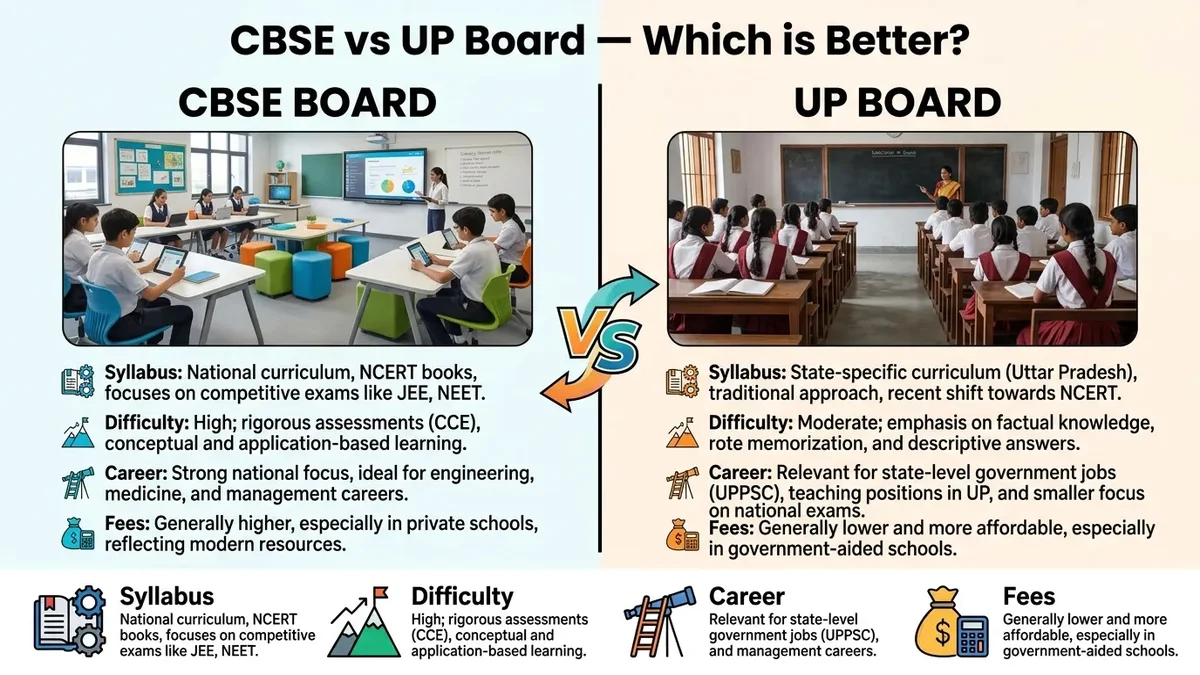
What Are the Key Differences? � Quick Comparison Table?
Here is a simple table. It shows the main differences in 30 seconds.
| Feature | CBSE | UP Board |
|---|---|---|
| Who runs it | Central Government (CBSE) | UP State (UPMSP) |
| Syllabus base | 100% NCERT | NCERT adapted (Science/Maths) |
| Main language | English | Hindi (English in some schools) |
| Exam style | Application and problem-solving | Theory and descriptive (improving) |
| Best for JEE/NEET | Strong match (NCERT direct) | Good (with extra coaching) |
| Best for NDA | Better English for SSB interview | Good (practice English daily) |
| All-India acceptance | Universal | Universal (strong in UP) |
Pick CBSE if your child aims for JEE, NEET, or NDA with English confidence. Pick UP Board if you prefer Hindi medium and live in a UP Board-focused area.
Who Should Choose Which Board? � Guide for 2027?
Choose CBSE If...
- Your child wants to prepare for JEE, NEET, or NDA seriously.
- You want English-medium education from Class 9 onwards.
- You may move to another state or city in future.
- Your child learns better through activities and projects.
Choose UP Board If...
- Your child is more comfortable studying in Hindi.
- You live in a small town with mostly UP Board schools nearby.
- Board exam fees and school costs are a major concern.
- Your child will join extra coaching for competitive exams anyway.
Key Academic Dates 2027
| Event | CBSE | UP Board |
|---|---|---|
| Class 10 board exam | Feb�March 2027 | Feb�March 2027 |
| Class 12 board exam | Feb�March 2027 | Feb�March 2027 |
| JEE Main 2027 | Jan & April 2027 | Jan & April 2027 |
| NEET 2027 | May 2027 | May 2027 |
Check official sites for final dates: cbse.gov.in, upmsp.edu.in, ncert.nic.in
What Will Your Child Study in the Syllabus?
JEE and NEET are both based on NCERT books. CBSE uses these books directly in class. UP Board has adopted NCERT for Science and Maths in most schools now.
Science Syllabus Comparison
Physics (Class 11�12 focus areas)
- Mechanics and laws of motion
- Thermodynamics and waves
- Electrostatics and current electricity
- Optics and modern physics
Both boards cover these topics. CBSE teaches them with more lab work and numerical problems.
Chemistry (Class 11�12 focus areas)
- Physical chemistry and mole concept
- Organic chemistry reactions
- Inorganic chemistry and periodic table
NCERT Chemistry is the base for NEET. CBSE students read the same books in school daily.
Exam Pattern Comparison
| Criteria | CBSE | UP Board |
|---|---|---|
| Question type | MCQ + short + long answers | MCQ + descriptive answers |
| Internal assessment | Projects, practicals, activities | Practicals and internal tests |
| Grading style | Generally high scoring | Strict marking in some subjects |
| NCERT alignment | Direct (100%) | Adapted (Science/Maths mostly) |
For JEE and NEET, buy NCERT books even if your child is on UP Board. Read them alongside school textbooks.
How to Prepare � What Is the Step by Step Plan?
Step 1: Pick the board based on your goal
If JEE or NEET is the main goal, CBSE gives a smoother path. If UP Board is your only option, add NCERT books from Class 9 itself.
Step 2: Buy NCERT books today
Download free PDFs from ncert.nic.in. These are the base for JEE, NEET, and board exams. Read them before any guide book.
Step 3: Fix a daily study routine
Your child should study two hours daily beyond school homework. Use this time for NCERT reading and competitive exam practice.
Step 4: Practice English every day
UP Board your child must practice spoken English for NDA SSB. Read English newspapers aloud for 15 minutes daily. It builds confidence fast.
Step 5: Join coaching at the right time
Start JEE or NEET coaching from Class 11. For NDA, begin Maths and GK prep from Class 9. Do not wait until Class 12.
What Are the 5 Mistakes Parents Must Avoid?
- Mistake 1: Thinking board choice alone decides success
No board guarantees a JEE or NEET rank. Hard work and good coaching matter more. Pick a board and then focus on daily study habits. - Mistake 2: Ignoring English on UP Board
UP Board students can clear NDA written exams easily. But the SSB interview tests spoken English hard. Start English practice from Class 9. - Mistake 3: Skipping NCERT books
Many parents buy thick guide books but ignore NCERT. JEE and NEET questions come directly from NCERT. Read NCERT first, always. - Mistake 4: Switching boards too late
Changing from UP Board to CBSE in Class 11 is very hard. Your child will feel lost in English-medium classes. Decide the board by Class 9. - Mistake 5: Comparing marks across boards unfairly
A 85% in UP Board and 85% in CBSE are not the same. Do not pick a board just because marks look higher. Focus on exam preparation quality.
People Also Ask
Q: Which board is better for JEE and NEET?
A: CBSE is better because it follows NCERT directly. JEE and NEET are both based on NCERT books.
Q: Is UP Board syllabus same as CBSE now?
A: Mostly yes for Science and Maths. UP Board uses NCERT books in many subjects. Language medium and exam style still differ.
Q: Does board matter for NDA?
A: NDA accepts all boards. CBSE helps with English for the SSB interview. UP Board your child should practice spoken English daily.
Q: Does CBSE guarantee a JEE rank?
A: No. Success depends on hard work and coaching. CBSE just gives a smoother NCERT-based path for preparation.
Q: Can UP Board students clear NDA?
A: Yes. Thousands do every year. Practice English speaking and general knowledge alongside school studies.
CBSE and UP Board both work for competitive exams. CBSE gives a direct NCERT path and better English practice. UP Board works well if you add NCERT books and English practice early. Pick based on your child's comfort and your family's plan.
If you live in Amroha, Joya, or nearby areas of UP, Jai Govind Public School is a CBSE school with coaching for JEE, NEET, and NDA. Call +91 9997161490 to know more.
Rifaul Hasan
Principal & Academic Expert, JGPS
Rifaul Hasan has over 15 years of experience guiding students for competitive exams like Sainik School, JNVST, and AMU. His mission is to make quality education accessible to every child through structured learning methodologies.
View Full Profile