Announcement
Admissions Open for Session 2026-27 (Nursery to Class 8)Special Coaching Batches for AMU, JMI, Sainik School, and Vidyagyan!Call Admissions Desk at +91 9412137554Submit Online Form to reserve your evaluation seatAdmissions Open for Session 2026-27 (Nursery to Class 8)Special Coaching Batches for AMU, JMI, Sainik School, and Vidyagyan!Call Admissions Desk at +91 9412137554Submit Online Form to reserve your evaluation seat
View Process →
Home/Blog/Feynman Technique AMU Math 7 mins read

How to Master Mathematics for AMU Class 6 Using the "Feynman Technique"

Neha Singh
Neha SinghStudy Habits Expert
July 4, 2026

Your child writes the same maths formula 20 times in a notebook. They can recite it perfectly. But the moment a word problem appears, they freeze. This happens because memorizing is not the same as understanding. About 8 out of 10 students fail the AMU Class 6 maths section for this exact reason.

There is a simple fix. It is called the Feynman Technique. It was created by Nobel Prize-winning physicist Richard Feynman. And your child can use it tonight.

What Is the Feynman Technique?

The Feynman Technique is simple. If you cannot explain something in plain words, you do not really understand it. Most children think they know a topic after reading it. But when the exam twists the question, their memory breaks down.

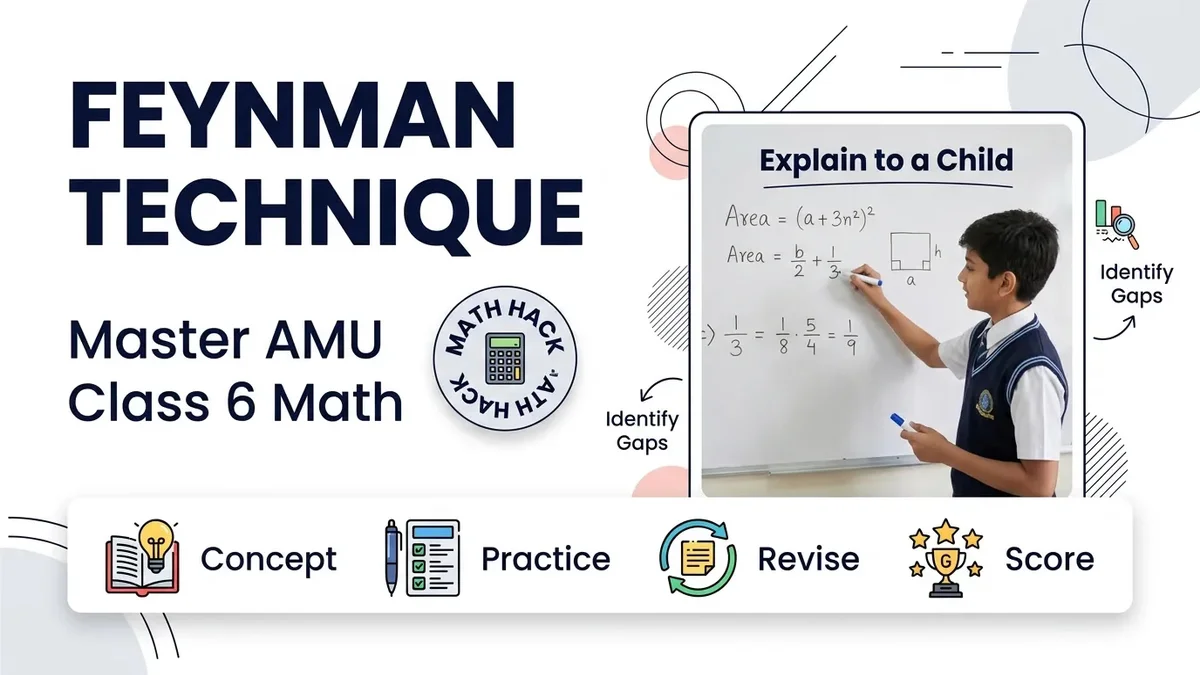
This technique flips the roles. Your child stops being the student. They become the teacher. They explain the concept to someone younger. If they get stuck, that is where the real learning begins.

It works because teaching forces the brain to organize information. Reading does not do that. Your child will remember the concept much longer when they explain it out loud.

MethodHow It WorksBest For
Rote LearningWrite formulas 20 times and memorizeShort-term recall only
Feynman TechniqueExplain the concept in simple words like a storyAMU word problems and deep understanding

Who Can Use This Technique?

This technique works for any student in Class 4 to Class 9. It is most useful for children preparing for maths-heavy entrance exams. Here is who benefits most:

  • Students preparing for AMU Class 6 entrance exams
  • Children getting ready for JNVST maths sections
  • Any child who understands formulas but fails word problems
  • Students who score low in maths despite hours of practice

You can start this technique at home tonight. No extra books or coaching needed.

What Will Your Child Learn?

Your child will learn to break down hard maths topics into simple stories. Here is what changes when they use the Feynman Technique:

They stop memorizing blindly. Instead, they ask themselves "why does this formula work?" That question changes everything.

They catch their own gaps. When they try to explain and get stuck, they know exactly what to review. No more guessing.

They handle word problems with ease. AMU exams love wrapping maths in long paragraphs. A child who can teach in stories will not panic.

How to Use the Feynman Technique at Home � Step by Step?

  1. Pick one topic: Choose a maths topic your child finds hard. Start with Profit and Loss or Fractions.
  2. Give them a blank page: Ask them to write everything they know about it. No books allowed during this step.
  3. Make them teach you: Tell them to explain it to you like you are in Class 2. They cannot use big words like "Cost Price" or "Selling Price."
  4. Find the gaps: When they get stuck, ask a simple follow-up question. That gap is where the real learning happens.
  5. Go back to the book: Now let them open the textbook. They will read with purpose because they know what they missed.

What Are the 5 Mistakes Parents Must Avoid?

  1. Making them write formulas repeatedly: Writing 20 times does not build understanding. It only builds short-term memory that fades fast.
  2. Rushing to the next topic: If your child struggles with one concept, do not move on. Master it first with the Feynman method.
  3. Using big words during practice: If your child uses terms like "numerator" or "denominator" without knowing what they mean, they are still memorizing.
  4. Skip the "teach back" step: The whole point is the teaching. If your child just reads the solution, the technique does not work.
  5. Getting frustrated when they get stuck: Getting stuck is the best part. It shows the exact spot where learning needs to happen.

People Also Ask

Q: Can my child use this technique for all subjects?

Yes. The Feynman Technique works for science, maths, and even history. Any topic that requires understanding benefits from teaching it in simple words.

Q: How long does each session take?

About 15 to 20 minutes per topic. That is enough to cover one concept well. Do not try to do too many topics in one sitting.

Q: What if my child refuses to teach out loud?

Start with a stuffed toy or a younger sibling. The key is that they say the words out loud. Even teaching a pet works.

Q: Does this work for AMU entrance exams?

Yes. AMU exams test understanding, not memory. The Feynman Technique is one of the best ways to prepare for their tricky maths questions.

Q: How soon will I see results?

Most children show improvement within 1 to 2 weeks. They start solving word problems faster and with more confidence.

Important Links


Your child does not need more study hours. They need the right way to study. The Feynman Technique is a simple tool that changes how your child thinks about maths. Start tonight and see the difference in a week.

At Jai Govind Public School (JGPS), we teach students to understand, not just memorize. If you want help with your child's maths preparation, call us at +91 9997161490. Let us build strong maths foundations together.

Neha Singh

Neha Singh

Study Habits Expert, JGPS

Neha is obsessed with productivity and effective learning strategies.

View Full Profile

Share this article

Article Tags

Study HabitsAMU PrepFeynman TechniqueMath Tricks
Neha Singh

Neha Singh

Study Habits Expert

Neha is obsessed with productivity and effective learning strategies. She helps students study smarter, not just harder.

View all articles →

Important Links